

Borges’ unending library. via Asel Yeszhanova, gutenbergspace.wordpress.com
Since November, a number of conversations have gathered around the idea of a “Public Library of Humanities“ — an Open Access scholarly publishing platform for Humanities / Social Sciences (HSS), inspired by Public Library of Science (PLOS) I attempted to gather and review this background in “Public Library of Humanities: Envisioning a New Open Access Platform.” on Dec 20.
[Subsequently, it’s become evident that “PLOH” or “PLOHSS” would raise trademark concerns with PLOS, so the alternative Open Library of Humanities, OLH, has been proposed].
[UPDATE Tues 1/22 8pm GMT, the project site is now live at OpenLibHums.org].
Here’s my envisioning of what Open Library of Humanities could be, adapted from posting to email discussion with PLOHSS / OLH co-organizers/advisors on January 7th.
Short-form list:
- Humanities, broadly defined to included Social Sciences, Arts, Design, etc.
- Expertise, impact, scale, quality brand/look/feel – become a standard-setter and transformer for the domain
- Post-publication Review: explore overlay, megajournal, & pre-publication review models
- Tackling key pain-points and missions of all scholcom players.
- Attractive value proposition for current journals/editors to move onto PLOHSS system.
- Lean cost structure
- Integration of journals and books.
- Open Source
- Not-for-profit
- International – at least trans-Atlantic.
- An exchange for different disciplines and innovation areas.
- New avenues to public engagement, not just academic impact
- Exploration of new editorial models, e.g. blog curation, peersourcing.
- Innovation driven.
1) Humanities broadly defined to included Social Sciences, Arts, Design, etc. There was discussion about what scope to lay out, and whether/how to incorporate the term HSS (Humanities / Social Sciences). In the end, it seemed advantageous to have a simpler name, and intend “Humanities” in a broad sense that could extend to Social Sciences and other areas.

Boullée, “Project for a Royal Library”
2) An org/platform with the expertise, brand, impact, and scale to become a standard-setter and transformative innovator. Immediate quality look, feel, functionality that says: solid, cutting-edge, the ship you want to be on. Claim and earn a position as the leader in delivering openness, impact, usability, cost-effectiveness, and quality operation.
3) Post-publication review: explore overlay, megajournal, & pre-publication review models

project for Brabant Library, Netherands, by MVRDV
There is strong interest in exploring the possibilities of a PLOS ONE (aka “megajournal”) model of acting as an infrastructure and quality guarantor, but not gatekeeper or reviewer. I hypothesize that low-barrier-to-access to a highly-regarded and impact-generating platform is a strong value proposition to HSS researchers, currently faced with mostly slow, restricted-audience, low-impact journals. However, existing or new “full” pre-publication-review journals could, conceivably, operate as “overlay” journals on top of a megajournal or even an unrestricted archive — as in Timothy Gowers‘ recently-announced Episciences Project.
In all cases, I view these as hypotheses to be investigated and refined based on learning from and with scholcom players, particularly HSS scholars.
4) Innovatively and directly tackle key pain points and missions of scholarly-communication players, to quickly become a preferred option.
- For funders: open access and public impact:
- For authors: fast, open review process, affordability, reputation, impact evidence.
- For universities, REF impact, positive exposure for staff and university, open access, etc.
- For libraries, good technical implementation, metadata, integration with other systems, discoverability in search engines and integrated search tools.
- For readers/researchers, excellent and cross-device usability, integration with other tools/platforms such as Kindle, iPad, Readability/Instapaper, Mendeley .
5) Compelling value proposition for current journals/editors to move onto OLH system.
6) Lean Cost Structure A project that starts fresh and looks rigorously at how to shed the baggage and cost structure of existing systems. Question legacy requirements that may be eroding in relevance.
7) Integration of journal and book.

from Multigraph project, McGill Univ. Interactingwithprint.org
The separations between post, article, journal, chapter, book are increasingly strained or artificial. I think OLH might carve out new territory and leadership by building an integrated approach from the start. Continuous publication of articles, various ways to aggregate articles into “book” forms, etc. Currently, many publishers and platforms are laboriously building ways to do such dis- and re-aggregation, across systems conceived separately. I note that this integrated approach would push into the territory of Open Access monographs, which is fresher soil even than OA journals. But that’s a good thing — be in the lead!
8) Open Source. I wouldn’t want to say required, but it seems very advantageous to keep as much as possible plugged in to stable, community-run platforms, e.g. Open Journal System, WordPress, Annotum, Booktype, or PressBooks. In can be deadly to get bogged down in proprietary solutions to problems that a bunch of people have and could be (or are) solving collectively.
9) Not-for-profit. While I don’t inherently privilege not-for-profit over for-profit, my sense at the moment is that a not-for-profit model in the case would have an advantage in claiming the right-to-play and the PLOS precedent, and winning the involvement of universities and funders.
10) International – at least trans-Atlantic. I see advantage in aiming from the start to have an international presence – at least, English language, US and UK. There are somewhat different concerns on front-burner between US, UK, and other countries, which from a cosmopolitan and comparative perspective I tend to value paying attention to. But more to the point, US and UK are just two major poles and markets and producers, any major scholarly/publishing enterprise wants to be represented in both places. As with PLOS, being international I think helps signal ambition and scale. 
11) An exchange for different disciplines and innovation areas (as well as different countries). As a relative non-specialist, I have an interest or foot in a variety of areas, such as Digital Humanities, the MOOCs and online learning platforms associated with Stanford, LSE Impact of Social Sciences, REF (Research Excellence Framework) debates, many emerging projects in journalism and public media, etc. I often have the feeling there’s an opportunity to share innovation between domains that aren’t in much dialogue. For example, in US “digital humanities” there are great projects and platforms rethinking the process of creating, peer-reviewing, and publishing monographs, but this doesn’t seem much known about in the UK or in social sciences. By being international and cross-disciplinary, and having scale/resources for technical leadership, I envision OLH as a force to help innovation spread across fields more easily.
12) New avenues to public engagement:

Open University, UK
A project that looks to revitalize interaction between researchers and broader publics: e.g. education, policy, local history, journalism. This is an area where an OLH might particularly explore new territory, going beyond merely making current academic work Open Access, but leading in areas such as public-impact altmetrics, social-media dissemination, and bridging from specialist academic work to broader-audience forms like newspaper/magazine publishing, trade books / ebooks / e-singles. It might take some model from, or potentially work together with, channels such as The Guardian’s Higher Education Network, or Public Inquiry The New Inquiry magazine.
13) Exploration of new editorial models. Distributed editorial models such as explored by PLOS, Frontiers, eLife, even Wikipedia and non-academic models. Also, blog networks such as London School of Economics blogs or HASTAC. Open Peer Review, as in the MediaCommons model. A provocative suggestion was made by Patrick Dunleavy of LSE in his post “Ebooks herald the second coming of books in university social science“, in which he suggests a 3-part communications model: e/books are the long form, multi-contributor blogs the short-form, and Twitter the news stream. So you might imagine, what would the platform designed for that look like and how be built?

Industrial Workers of the World poster, 1911, via Wikipedia.
I think that as the LSE Impact of Social Sciences blog for example shows, a comparatively open-to-all blog can be a locus of high-quality and high-impact conversations, if it is managed well. It seems there are virtuous circle and trust-network effect, so people recognize the value of posting there and do a really good job with it. I think of the above as different points in the “low end” (bottom of the pyramid?) which lies between high-APC (Article Processing Charge) OA selective journals on one hand, and personal blog posts or unpublished work at the other. PLOS ONE figured out a very successful and revenue-generating position in that space, posing the question of whether/how an Open Library of Humanities might also.
14. Innovation Driven. I hope this point is implicit in the above, but I’m adding it for emphasis and conclusion. For me the big picture is about tackling hard, interesting problems in new ways, realizing new potential, breaking old logjams, and getting to better solutions all around. That means championing missions, not current forms or practices necessarily.
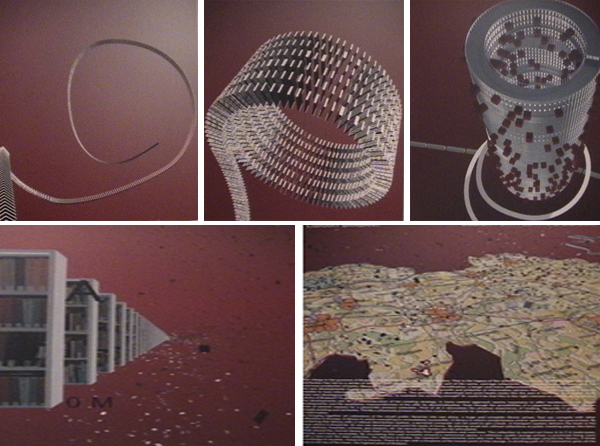
project for Brabant Library, Netherands, by MVRDV
Consider this one of those BELATED responses; I’ve been following the OLH experiment/start-up with great interest, and I think the outline of objectives here for the possible future(s) of the initiative are fantastic, but I offer some cautionary notes [“cautionary” may not be quite the right term; “food for thought” is more like it], esp. relative to some of the concerns that do make humanities [as well as social science + art/design] scholarship unique in terms of their publishing environments. For example, in the sciences, PLoS is pure genius, in my mind, because in that discipline it’s imperative to get research/results out there as quickly as possible and to make that information available for review, comment, and re-testing: this literally moves the sciences forward in vitally important ways that traditional print journals actually impeded [due to their content taking too long to move into print, post-all sorts of blind review and also being somewhat hidden behind institutional paywalls]. Humanities publishing has the same problem [in terms of lag-to-publication, often laborious and non-transparent review protocols, non- or too limited/too expensive accessibility, etc.], but what the humanities wrestles with more than the sciences [esp. in non-social sciences study and the arts] is the question of: who wants/desires this research/writing, and why? It’s a much more nebulous realm — production- and reception-wise, and also in terms of how published products “count,” not just for tenure review and things like that, but, for a lack of a better descriptor … emotionally-aesthetically, and also in relation to how certain communities of scholars form around certain areas of interest [whether that be Victorian literature, or even more narrowly, the novels of Dickens]. Scholarly “products” have an aesthetic dimension, as well as an informational one and thinking about both, even within one large humanities main-frame, is important. This will be especially important, I think, more for monographs than journals, or loose articles/pieces. I’m in favor of post-publication review myself [as long as their is rigorous editing on the front end], but in the humanities, unlike in the sciences, people don’t just show up to review “results.” They mainly read and poach, or skim-read, and ignore/move on. Our work doesn’t depend on whether or not someone else’s “results” are valid + verifiable, and our fields develop more rhizomatically-idiosyncratically. This is why some sort of creative directorship with online humanities publishing is important — just something to think about. Because “one size” does not fit all. Otherwise, you lose desire, and we need that in the humanities.
I would also add that humanities disciplines, although often comprising all sorts of disparate specialties [like, say, medieval literary studies, eco-studies, sound studies, Civil War history, etc.] that don’t necessarily “talk” to each other [or, very well], often have shared theoretical interests that tend to emerge at [almost] the same time, but in different locations [whether blogs, conferences, special journal issues, special essay volumes, etc.], and something OLH could bring these strands together in new and exciting ways that would help make cross-disciplinarity more of a reality than it currently is [it’s more of a buzz-word than something most people “live” and do; more of a descriptor of one scholar’s, or two scholars’, practices than a true revolution in the way we produce knowledge. OLH has the potential to truly radicalize the development of theoretical innovation within the humanities, writ more broadly than it is now, while at the same time, it should think more about some of the good reasons why all fields within the humanities still need certain distinct modes of visibility.